002: In other words…
SEE: i.e. by Sofia Melka
Originally written 17 Jul 2026, in my garden.
What even is a villanelle?
A good question. “i.e.” was written as a sort-of fake (or liberated, as I prefer to think of it)
villanelle. It doesn’t follow all the rules precisely. A real villanelle comprises five tercets
followed by a quatrain with two repeating rhymes & two refrains. The first & third lines of
the opening tercet repeat alternately in the last lines of the succeeding stanzas. Then there’s
the rhyme scheme. That’s where I might’ve broken apart the form a little. (How real are
parentheses in the world of a poem?)
I’d gotten into villanelles at the time, around last autumn, because that summer I’d become
aggressively passionate about some of Dylan Thomas’ poetry. Three of his poems in
particular. Before them, though, I only knew one poem of his. My brother & I have seen
Interstellar maybe 15 times, so “Do not go gentle into that goodnight” was familiar
territory. Some afternoon or other, I became especially interested in its structure & refrains
(‘Rage, rage against the dying of the light’ & the titular ‘Do not go gentle into that
goodnight’). Eventually discovering the poem’s true nature (a villanelle!) would prompt
the decision to try writing one of my own. What would be most eye-opening, however,
was finding Penguin’s little white book of Thomas’ poetry in Topping’s. In it were the
poems “I see the boys of summer”, “If I were tickled by the rub of love” & “Foster the
Light”.
Dream-logic & breath-magic
I couldn’t believe them! I couldn’t believe him. I was absolutely floored by those three. The
way he ‘made sense’ drove me crazy. I couldn’t wrap my head around what he meant.
(Like what does it mean to ‘pluck a mandrake music from the marrowroot’?) The best way
I can describe it is, imagine you’re dreaming. You know how in a dream, all knowledge &
all meaning is latent? Just embedded. You don’t know how you know something, but you
just know it. Everything’s symbolic & self-evident. There’s no exact logic to it, but there’s
an organic order. It is as it is. Time passes differently, if at all. Everything’s hard to reach,
hard to remember, hard to describe. & to investigate the reality of the dream disrupts it.
Ruins it. (That’ s not the point of dreaming.) That’s what those poems did to me. How they
felt to read. & then, there were Thomas’ soundscapes. Those three poems are absolutely
made to be read aloud.
Take the sounding thickness of the last stanza of “If I were tickled by the rub of love” (‘Death's
feather on the nerve? / Your mouth, my love, the thistle in the kiss? / My Jack of Christ
born thorny on the tree?’). Take the second stanza of “I see the boys of summer”, how
Thomas becomes a trick on your tongue (‘These boys of light are curdlers in their folly, /
Sour the boiling honey; / The jacks of frost they finger in the hives; There in the sun the
frigid threads’). Take the rest of “I see the boys of summer”. These poems have some sort
of breath-magic. You put a voice behind them & they gain presence, flesh, a
full-bodiedness. They come with an appetite, too. Your voice becomes the root – vital,
radical, nourishing.
Upon discovering those three, the only points of comparison I could configure were some of
Sylvia Plath’s poems. Ones where her attention to sound is clear (‘the caustic ticking of
the clock’) & careful (‘this is the fruit of it: tin-white, like arsenic.’). Through those three
poems, Thomas became a singularity for me. He struck me. To me, he became the pioneer
of a new mode of expression just as I needed one. The old ways didn’t seem to work
anymore. He became a sort-of talisman I carried whenever I wrote. He shows up time &
time again. Like in the poem “Resolute” (also in ampersand poetry journal), the line ‘way
holly unholy stuck in the merrymake’ is a total Thomas-tribute. Or the second line of
“i.e.”, ‘Four-fingered sowed-clover pulse. So pulped to perdition’, borrows from his
tradition as well.
Johnny Panic & Sylvia Plath
Back to Plath. The time at which “i.e” was written held a return to her work. (She used to be
my Elvis.) It was through Plath, some years before, that I’d started writing poetry in the
first place. I was around fifteen & had joined a poetry-writing lunch club at my high
school. You could say it was a small group. (The three boys who ran it + me) (+ Lucy
eventually.) About a week before the first session, I thought I ought to read some sort of
poetry book to figure out what one ‘does’ with poetry. I had no clue. (This may still be
true.) Looking through the different names in our library’s POETRY section, I was called
to a little cream-coloured book, the only one with no title on the spine. This is how Plath
& I meet. It was a selection of her poetry. Once I started reading, I was immediately taken
with her slyness, her sharpness, her unusual use of language & her emotional bareness. It
was she who showed me what to ‘do’ with poetry i.e. What could be done.
The Johnny Panic figure of the poem comes from one of Plath’s short stories, my favourite one. I
love reading poets in prose (e.g. THE BELL JAR) (‘I took a deep breath & listened to the old
brag of my heart. I am, I am, I am’). The story, “Johnny Panic and the Bible of Dreams”,
draws from her year as a receptionist at the psychiatric division of the Massachusetts General
Hospital in Boston. ‘Every day from nine to five I sit at my desk facing the door of the office
and type up other people's dreams’. The protagonist is a secretary with a higher (ulterior)
motive. I won’t spoil the rest. I will say this, though. In it, fear is a figure called Johnny Panic.
In it, fear is many things. Fear is a body is electric is a teacher is a nightmare is an escape. I
loved the terrible intrigue of the lake of dreams, all subconscious & swirling. The most potent
part was the story’s end. ‘I am shaken like a leaf in the teeth of glory’. Totally electrifying &
colossal & of the mind/body/spirit: ‘His Word (...) illumines the universe’. His angels are
‘blue-tongued’ & ‘lightning-haloed’. He forgets not his own.
One of the refrains in “i.e.” came from a phrase sideways-scrawled into the margins of one of my
old notebooks: ‘Johnny Panic is never eating and never sleeping’. Even years later, he was
hard to shake. I guess this poem takes the idea of fear, agitation & the eternal (but corrosive)
body & tries to run someplace with it. I’m not sure where exactly. Soon after finishing it,
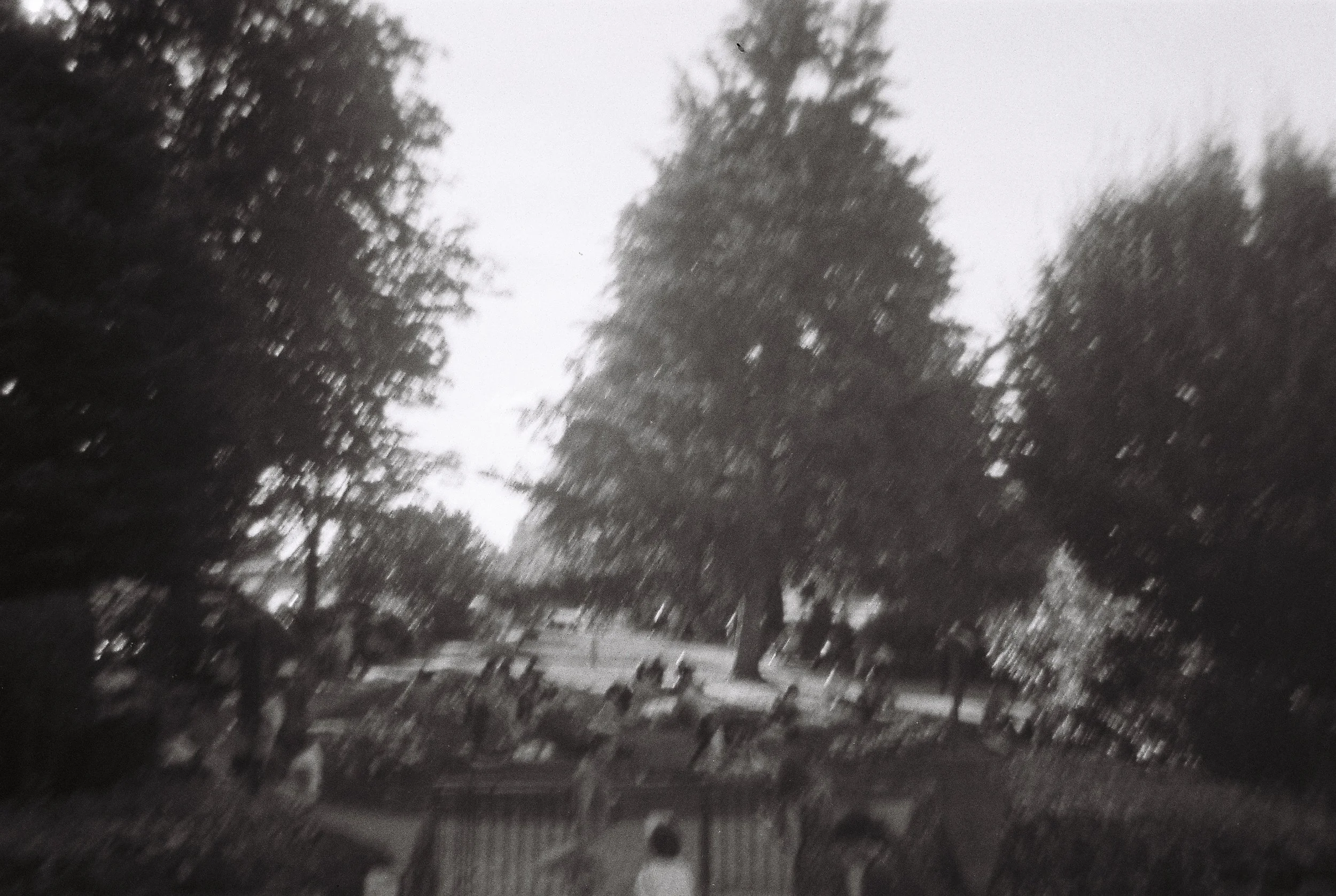
“i.e.” was published in ampersand’s COHESION & CHAOS issue. Its cover photo in
ampersand was taken on a disposable camera in a Paris heatwave. There was this gorgeous
park full of lounging couples & sprawling picnics. It was a long time ago, but I think I was
either too hesitant or in-a-rush to fully stop to take the photo. The result, though, in all its slant
& blur, suits the poem in its haze of Panic and becoming.